By Aislinn Ozawa Burns, MSN, PMHNP-BC
Pharmacokinetics and pharmacodynamics sound like two terms you should remember from graduate school but probably mixed up at least once while studying.
The simplest distinction still works:
Pharmacokinetics: what the body does to the drug.
Pharmacodynamics: what the drug does to the body.
The useful next step is following a medication problem from the first change to the clinical outcome. A drug level rises. A patient becomes sedated. Both concepts may be involved, but they explain different parts of the story.
This guide builds on the pharmacologic foundations in The PMHNP Playbook with case reasoning and common points of confusion. Once you can explain the mechanism, try the pharmacokinetics and pharmacodynamics practice questions.
Pharmacokinetics vs. Pharmacodynamics: The Simple Difference
Ask two questions:
What changed the medication's concentration or movement? Think pharmacokinetics: absorption, distribution, metabolism, excretion, clearance, and half-life.
What response did the medication produce at its target? Think pharmacodynamics: receptor activity, therapeutic effects, adverse effects, potency, and efficacy.
A higher concentration can produce a stronger effect. That connection does not make the two terms interchangeable.
| Pharmacokinetics | Pharmacodynamics |
|---|---|
| What the body does to the drug | What the drug does to the body |
| Absorption | Receptor binding |
| Distribution | Mechanism of action |
| Metabolism | Agonist or antagonist activity |
| Excretion | Therapeutic effects |
| Half-life | Adverse effects |
| Drug concentrations | Dose-response relationship |
The FDA describes pharmacokinetics as absorption, distribution, metabolism, and excretion, while pharmacodynamics describes the drug's effects on the body.
A simple way to remember it is:
PK = the medication's journey.
PD = the medication's effect.
Pharmacokinetics: Follow ADME
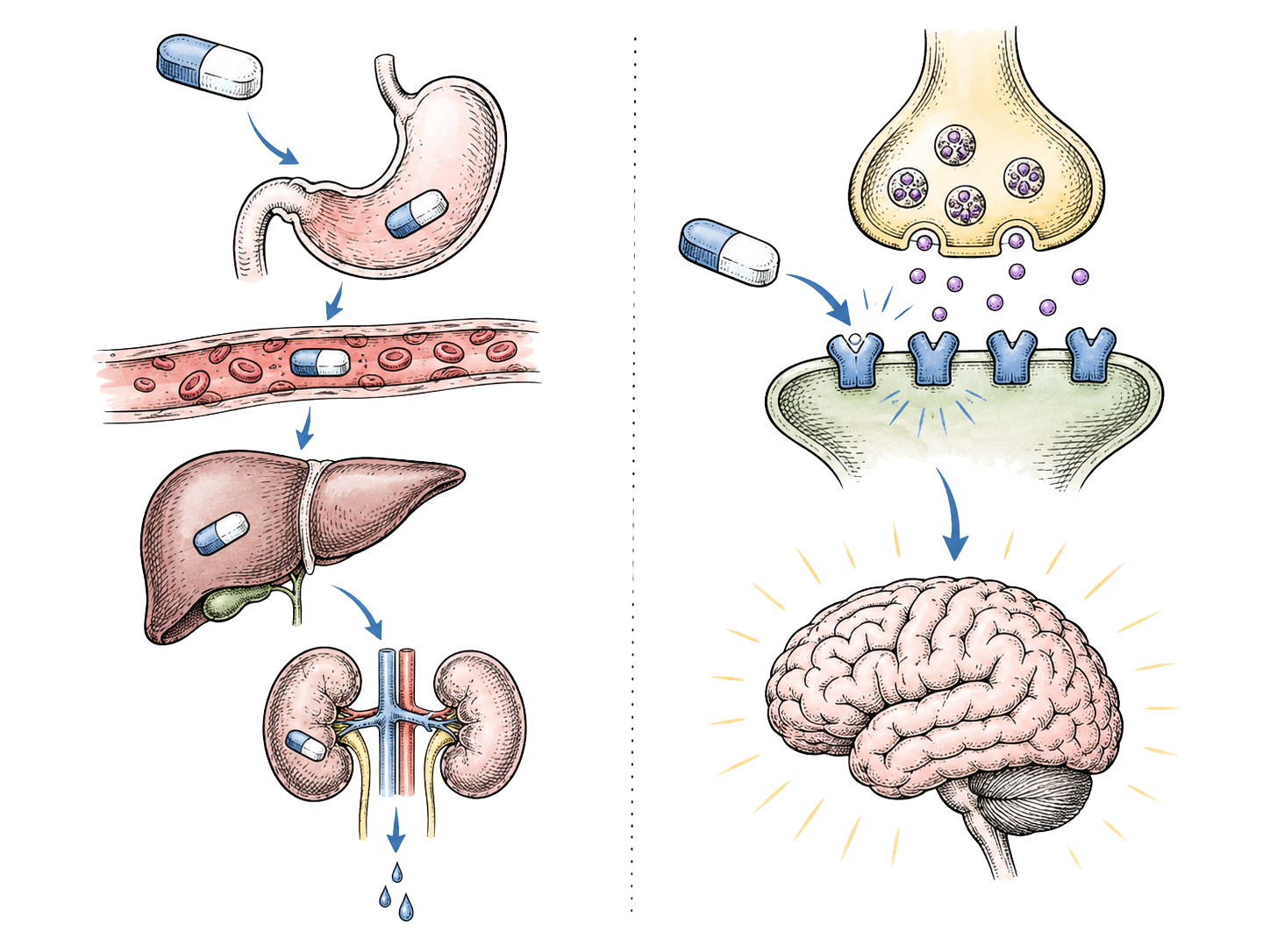
Pharmacokinetics describes how a medication gets into the body, where it goes, how it is processed, and how it eventually leaves.
Use the acronym ADME:
Absorption
Distribution
Metabolism
Excretion
You don't need to turn every pharmacokinetics question into a chemistry problem. Most of the time, you just need to identify which part of ADME is being affected.
Absorption: How the Drug Enters the Bloodstream
Route, formulation, food, and gastrointestinal conditions can change how quickly or how much medication reaches the bloodstream. Bioavailability describes the fraction of a dose that reaches systemic circulation unchanged.
With many oral medications, metabolism in the intestinal wall and liver reduces the amount reaching systemic circulation. This is first-pass metabolism. Intravenous administration delivers medication directly into systemic circulation and has no absorption step.
Common trap: assuming that every medication interaction in the stomach can be fixed by separating doses. Some interactions involve prolonged changes in stomach pH; others involve drug metabolism. Check the specific medication and interaction before deciding that timing is the problem.
For example, omeprazole can inhibit CYP2C19 and reduce citalopram clearance. That points toward increased exposure, not a general rule that acid-reducing medications make SSRIs ineffective. The Celexa prescribing information addresses this interaction and its dosing restrictions.
Distribution: Where the Drug Goes
Distribution involves movement between blood and tissues. Blood flow, body composition, protein binding, and the ability to cross barriers all matter.
The unbound portion of a medication is available to interact with its target. A total drug concentration includes both bound and unbound drug, so the number needs context.
Case reasoning: a patient taking valproate has low albumin and concerning adverse effects, but the total valproate level appears reassuring. Do not dismiss the symptoms because of that number. Altered binding can increase the free fraction, and total concentrations may be misleading. A free level may help clarify exposure when clinically indicated. The valproic acid label describes this problem in hepatic and renal disease.
Metabolism: Which Pathway Changed?
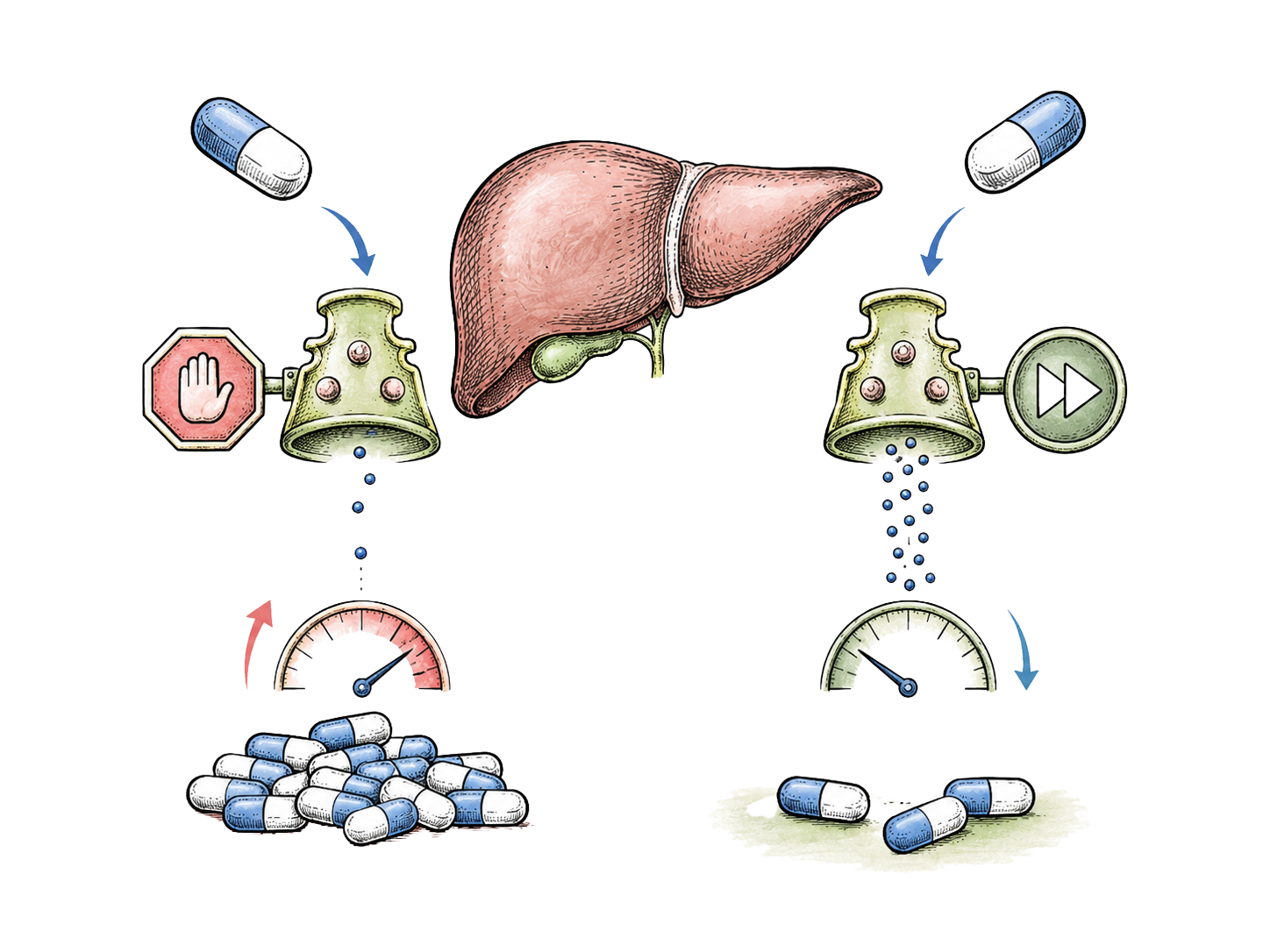
Many psychiatric medications undergo hepatic metabolism, including metabolism by CYP450 enzymes. Start by identifying the substrate: the medication being processed by the affected enzyme.
Inhibition: less metabolism of an active substrate can mean higher concentrations.
Induction: more metabolism of an active substrate can mean lower concentrations.
These are useful starting rules, not predictions for every possible combination. The specific enzyme matters. Prodrugs and active metabolites can complicate the pattern.
Case reasoning: a patient stable on clozapine stops smoking during a hospital admission. The prescribed dose has not changed, but exposure can increase as tobacco-smoke-related CYP1A2 induction wears off. The clozapine label advises considering dose reduction when an inducer is discontinued.
The inducing effect comes from tobacco smoke rather than nicotine. A nicotine patch does not maintain that induction. Smoking changes warrant a medication review and appropriate monitoring; see NHS Specialist Pharmacy Service guidance.
Board reasoning: same dose does not guarantee the same drug exposure.
Excretion: How the Drug Leaves
Kidney function matters especially when a medication depends on renal elimination. Reduced clearance can increase exposure and prolong the time needed to eliminate the medication.
Case reasoning: a patient taking lithium develops worsening tremor and confusion after starting a thiazide. Think about reduced lithium clearance and possible toxicity. The symptoms require prompt assessment rather than waiting for a routine follow-up.
The lithium label identifies diuretics, NSAIDs, and renin-angiotensin system antagonists as interactions that can raise lithium concentrations. Follow the patient's symptoms, kidney function, electrolytes, medication history, and appropriately timed lithium levels.
Do not automatically reduce every psychiatric medication because a patient has kidney disease. Identify how that particular medication is cleared and use its prescribing guidance.
Half-Life and Steady State: Work Through the Clock
Half-life is the time required for a drug concentration to decrease by half during the relevant elimination phase.
For a medication with first-order elimination and stable clearance, approximately four to five half-lives brings regular dosing close to steady state. At steady state, drug input and elimination balance over the dosing interval. Concentrations can still rise after a dose and fall before the next one.
Try a simple example: a medication has a 24-hour half-life. With consistent dosing and unchanged clearance, it approaches steady state in roughly four to five days. After a dose change, the concentration also needs time to approach its new steady state.
Do not turn that estimate into a promise about symptom relief. Steady-state concentration and full therapeutic response are different endpoints. Sertraline, for example, reaches steady-state concentrations after about a week of daily dosing, according to its prescribing information; that does not establish an adequate antidepressant trial.
Active metabolites, nonlinear kinetics, changing organ function, and long-acting formulations can make a simple half-life estimate less useful. Follow drug-specific monitoring and washout instructions.
Pharmacodynamics: What Happens at the Target?
Pharmacodynamics connects a medication's action with its effects. Receptors are important, but psychiatric medications can also act through transporters, enzymes, or ion channels.
Agonist: activates a receptor.
Partial agonist: produces less maximal receptor activation than a full agonist in the same system; competition with a full agonist can reduce the overall response.
Antagonist: blocks receptor activation without intrinsic activating activity.
Inverse agonist: reduces constitutive receptor activity below its baseline.
Aripiprazole's partial agonism is a useful association, but “stabilizes dopamine” is a teaching shorthand. It does not mean the medication measures a patient's dopamine level and automatically adjusts itself.
Affinity, Potency, and Efficacy
Affinity: how readily a drug binds to its target.
Potency: the dose or concentration needed to produce a specified effect.
Efficacy: the maximum effect achievable in the system being compared.
If two drugs produce the same maximum effect but one requires a smaller dose, that drug is more potent. You still need other information to decide which medication best fits the patient.
A narrow therapeutic index means effective and toxic exposures are relatively close. Formally, the therapeutic index is a ratio of toxic to effective doses, not a subtraction. Lithium is an important example of a medication with a narrow safety margin.
Where Pharmacokinetics and Pharmacodynamics Meet

Follow this sequence:
Enzyme inhibition → reduced clearance → higher concentration → increased sedation.
Reduced clearance and increased concentration describe pharmacokinetics. Sedation describes the pharmacodynamic outcome.
Now change the scenario: two medications both cause sedation, and their effects add together without either medication changing the other's concentration. That is a pharmacodynamic interaction.
When a question contains both concepts, read the final sentence carefully. “Why did the level rise?” and “What effect did the medication produce?” are asking different things.
How to Approach a PMHNP Pharmacology Question
Find what changed. A new medication, missed doses, smoking status, kidney function, route, or formulation?
Name the mechanism. Absorption, distribution, metabolism, excretion, or a target-level effect?
Predict the direction. Would exposure increase, decrease, or stay similar while the response changes?
Check the clinical consequence. Loss of benefit, adverse effects, toxicity, or a monitoring need?
Answer the question actually asked. Mechanism questions and next-step safety questions require different answers.
The ANCC test content outline includes pharmacokinetics and pharmacodynamics within advanced psychopharmacology. It does not reveal the live questions or guarantee a particular case will appear.
Frequently Asked Questions
Are medication side effects pharmacokinetic or pharmacodynamic?
The side effect itself is a drug response, so it is pharmacodynamic. A pharmacokinetic change may explain why exposure increased enough to cause it.
Does steady state mean the medication has fully worked?
No. It describes the balance of drug input and elimination. Clinical improvement may follow a different timeline.
Can stopping a medication cause an interaction?
Yes. Removing an inhibitor or inducer can change another medication's exposure. Review discontinuations and smoking changes as carefully as new prescriptions.
What should I memorize first?
Start with ADME, inhibitor versus inducer, half-life versus response time, and agonist versus antagonist. Then explain a case without looking at the answer.

The Takeaway
PK helps explain how much medication reaches the target and how long it stays. PD helps explain what happens when it gets there. Follow the sequence instead of memorizing the terms in isolation.
Put this into practice with the pharmacokinetics and pharmacodynamics questions, then return to the mechanism behind any missed answer.
Sources and Clinical Context
References are linked alongside the concepts they support, including ANCC's content outline, medication prescribing information, and NHS smoking-interaction guidance. The FDA's Clinical Pharmacology Section of Labeling guidance provides additional context for distinguishing pharmacokinetics and pharmacodynamics.
This article is for education and board review, not individualized prescribing advice. Use current drug-specific labeling and clinical guidance for patient care. The PMHNP Playbook is an independent resource and is not endorsed by ANCC.
If you're organizing your pharmacology review, work this topic into your 8-week PMHNP study plan rather than trying to memorize all of psychopharmacology at once.
And once you're getting close to test day, read my Prometric exam walkthrough so you know exactly what to expect at the testing center.
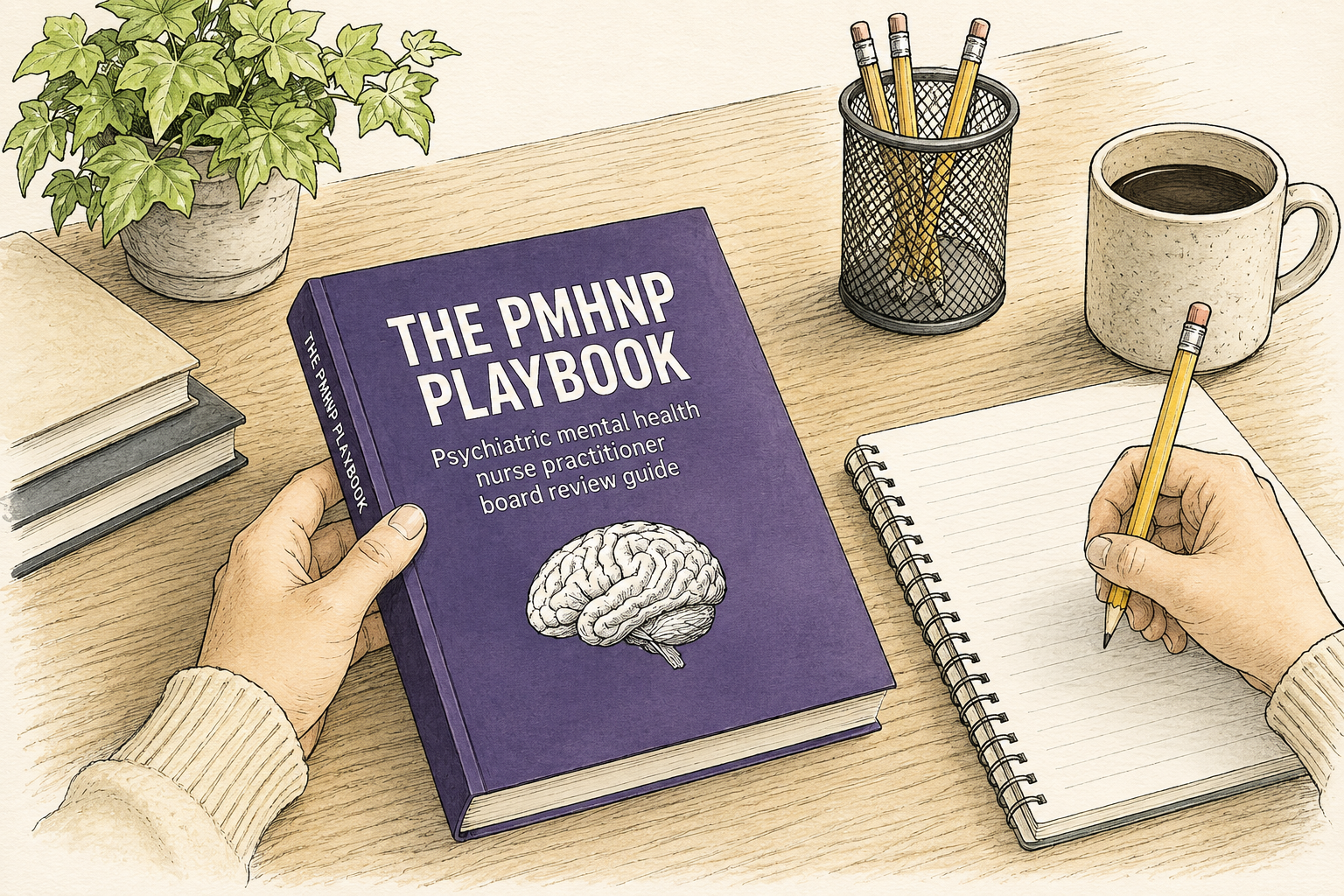
Want the full high-yield breakdown of psychopharmacology, mechanisms of action, medication interactions, adverse effects, and ANCC exam strategy? It's all covered in The PMHNP Playbook
Prefer digital? Buy the PDF edition
