How to Study for the PMHNP Exam in 8 Weeks (A Realistic Plan)

By Aislinn Ozawa Burns, MSN, PMHNP-BC
Eight weeks can feel like nothing when you look at everything the PMHNP exam covers. Mood disorders, psychopharmacology, psychotherapy theories, ethics, neurobiology, assessment, and more.
Here is the good news. Eight weeks is enough.
You do not need to study twelve hours a day. You do not need to buy every review course on the market. You do not need to put your life on hold for two months. You need consistency and a plan that focuses on what is actually tested.
This is the plan I would follow if I were starting today.
Know What You Are Actually Studying For
A lot of people approach this exam like a graduate school final, where the goal is to memorize everything you have ever read.
That is not what this exam is testing.
The ANCC wants to know if you can think safely as an entry-level psychiatric provider. That means your time is best spent on high-yield concepts: common diagnoses, medications, psychotherapy basics, ethics, and clinical decision-making. Not obscure facts buried in a textbook footnote.
Keep that in mind as you go through the next eight weeks. If something feels like trivia, it probably is.
This plan roughly mirrors how the exam itself is weighted. If you want to see how much of the exam each topic area actually represents, here is a breakdown of the five ANCC domains.
Weeks 1-2: Build Your Foundation
Start broad. The goal here is not mastery, it is reactivation. You already learned this material in school. You are knocking the dust off.
Cover:
Mood disorders
Anxiety disorders
Trauma-related disorders
Psychotic disorders
Personality disorders
Substance use disorders
Neurodevelopmental disorders
Psychiatric assessment
As you go through each topic, do a short set of practice questions, even just 10 to 20 a day. Practice questions will show you your weak spots faster than reading ever will. Pay attention to which topics you keep getting wrong. That is your real study list for the next six weeks.
This is also the right time to get comfortable with the major rating scales: PHQ-9, GAD-7, MDQ, CAGE, AUDIT, and similar. Know what a normal score looks like, where the cutoffs fall, and at what point a score signals that the presentation has moved beyond what therapy alone is likely to address. The boards like to test this kind of clinical judgment, and it comes up constantly in practice too.
Weeks 3-4: Psychopharmacology
This is the domain that touches everything else, so give it real time.

Review:
Antidepressants
Antipsychotics
Mood stabilizers
Anxiolytics
ADHD medications
Substance use treatment medications
For each class, know the mechanism of action, major side effects, monitoring requirements, black box warnings, and key drug interactions. This is also a good time to brush up on neurotransmitters, since the boards like to connect a medication's mechanism back to the neurotransmitter it affects.
Keep doing daily practice questions. By now you should start noticing patterns in how the questions are written.
Week 5: Psychotherapy and Theories
This is the smallest domain on the exam, and it is the one most students try to skip.
Don't.
Review:
CBT
DBT
Motivational interviewing
Supportive therapy
Family therapy
Group therapy
Humanistic approaches
Psychodynamic concepts
Defense mechanisms
Most of these questions are not asking you to function as a therapist. They are asking you to recognize the most therapeutic response in a given scenario. Open-ended, validating, and patient-centered is almost always the right direction.
One honest note: there are some details in this domain you will memorize, use to pass the exam, and likely never think about again. The founders of certain therapy approaches and some of the finer historical details fall into this category. Learn them well enough to answer a question, then let them go. Do not burn hours trying to make trivia stick long-term. It is not worth it, and it is not the kind of thing that matters once you are seeing patients.
Week 6: Ethics, Legal Principles, and Advanced Practice Skills
Review:
Informed consent
Confidentiality
Duty to warn
Tarasoff
HIPAA
Scope of practice
Documentation
Cultural considerations
Evidence-based practice
These questions tend to be some of the easier points on the exam once you understand the underlying principles. The boards are not testing whether you memorized a statute. They are testing whether you know when safety overrides confidentiality, when reporting is required, and how to handle a boundary issue.
This is also a good week to review quality improvement and research basics, since they tend to get lumped in here.
Week 7: Practice Questions and Rationales
This week is less about volume and more about understanding why an answer is right or wrong.
Work through a large set of practice questions, and for every single one, read the rationale. Including the ones you got right. Getting an answer correct for the wrong reason will not help you on test day, when the wording shifts slightly and your shortcut no longer applies.

As you go through rationales, look for patterns. Are you consistently missing questions in the same domain? Do you tend to pick the answer that treats first instead of the one that gathers more information? Do you overthink questions that are actually straightforward? The rationales will tell you more about how you think than the raw score ever will.
This is also where a lot of those harder-to-pin-down concepts finally click, because seeing the reasoning laid out next to the question sticks better than reading the same concept in isolation.
This is also a good week to get familiar with what to expect at the Prometric testing center. One less unknown on test day means more mental energy for the actual exam.
Week 8: Review and Refine
This week is about polishing, not rebuilding.
Review your weak areas
Revisit commonly missed practice questions
Review medication charts
Review diagnostic criteria
Review psychotherapy concepts
Review ethics and legal principles
Resist the urge to start something new this week. New material this late tends to create more anxiety than it resolves.
What I Would Not Do
Start three new review courses at once
Read multiple textbooks cover to cover
Spend hours comparing your progress to other people's
Sit in Facebook groups looking for reassurance instead of studying
None of those things move the needle. Focused, consistent study does.
A Final Thought
You will probably never feel completely ready. Almost everyone walks into the testing center thinking there was more they could have done.
That feeling is normal, and it does not mean you are unprepared. At some point, studying stops being about learning new information and starts being about trusting what you have already built. If that feeling tips into something closer to dread or panic, here is more on managing PMHNP exam anxiety.
Eight weeks is enough. Show up, do the work, and trust the process.
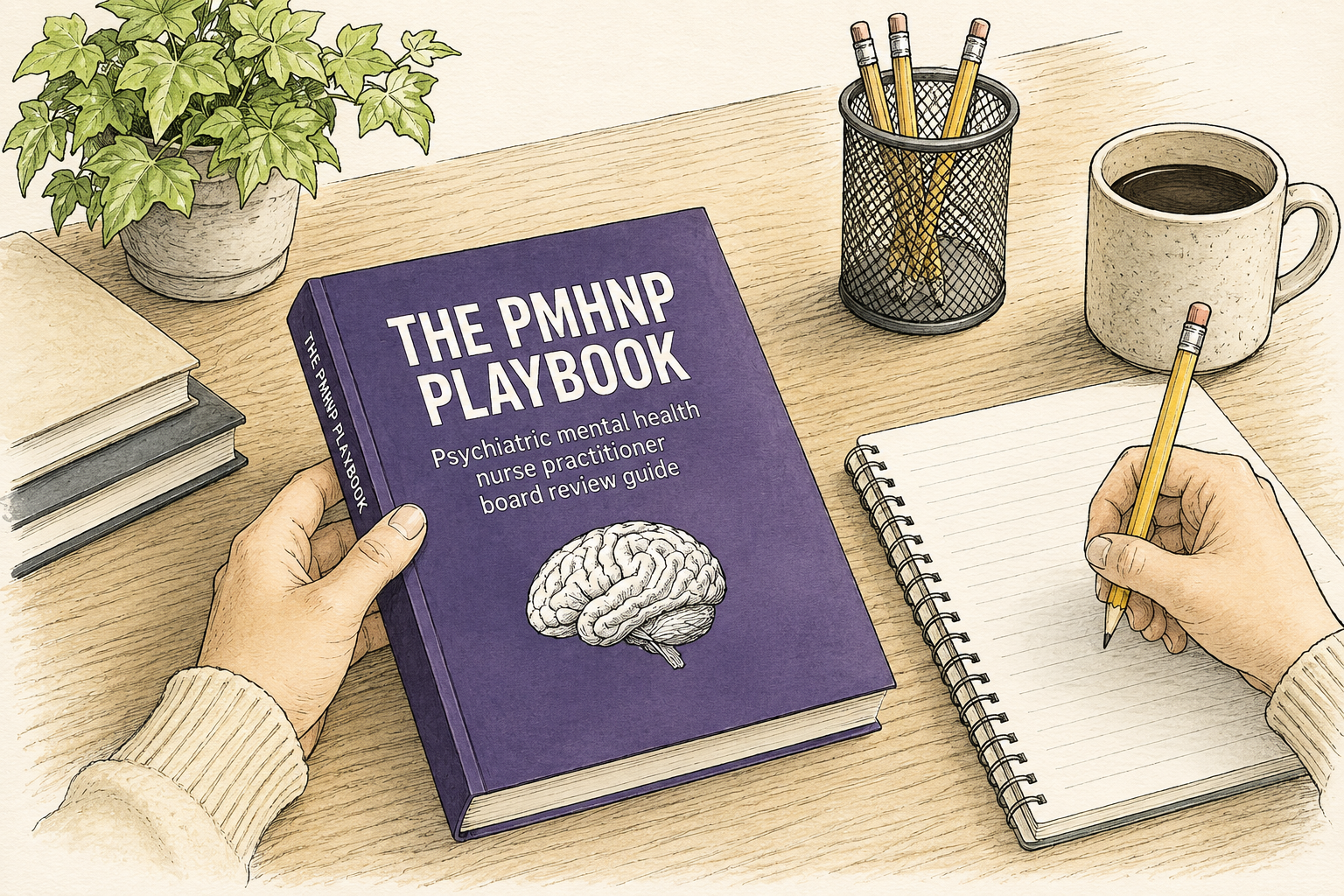
If you want a resource that follows roughly this same structure, organized topic by topic with practice questions and rationales built in, that is exactly what The PMHNP Playbook was designed for.
Prefer digital? Buy the PDF edition
