
By Aislinn Ozawa Burns, MSN, PMHNP-BC
One of the most confusing parts of preparing for the PMHNP board exam is figuring out what the ANCC is actually testing.
The content can feel endless. Psychiatric disorders, medications, neurobiology, screening tools, psychotherapy, ethics, legal concepts, and clinical decision-making all start to blur together, especially when you are trying to study while also working and living your life.
That is where the five ANCC PMHNP exam domains help.
The domains are not necessarily the order you need to study in. Think of them more like the official blueprint for the exam. They show you how the scored questions are divided and which knowledge and clinical skills the ANCC expects an entry-level psychiatric-mental health nurse practitioner to have.
For 2026 test takers, the current ANCC outline lists 175 total questions on the PMHNP-BC exam. Of those, 150 are scored and 25 are unscored pretest questions. You cannot tell which questions are unscored, so you should answer every question as though it counts.
What Are the Five ANCC PMHNP Exam Domains?
The five domains on the ANCC PMHNP board exam are:
Scientific Foundation: 33 scored questions, or 22%
Advanced Practice Skills: 41 scored questions, or 27%
Diagnosis and Treatment: 33 scored questions, or 22%
Psychotherapy and Related Theories: 17 scored questions, or 11%
Ethics, Legal Principles, and Cultural Care: 26 scored questions, or 17%
The percentages appear to total 99% because of rounding, but these five domains account for all 150 scored questions.

The percentages matter. Advanced Practice Skills is the largest PMHNP exam domain, with 41 of the 150 scored questions. Psychotherapy is the smallest, but 17 questions is still enough to affect your score. Ignoring an entire domain because it has the lowest percentage is not a great strategy.
Here is what each domain includes and what I would actually focus on while studying.
Domain 1: Scientific Foundation — 22%
Scientific Foundation includes the science behind psychiatric assessment and treatment.
According to the ANCC outline, this domain covers:
Advanced pathophysiology
Advanced pharmacology
Advanced psychopharmacology
Pharmacokinetics and pharmacodynamics
Medication interactions and adverse effects
Extrapyramidal symptoms and neuroleptic malignant syndrome
Neurodevelopment
Neuroanatomy
Neurophysiology
Psychopharmacogenomics
Advanced physical assessment
This can feel like the most academic section of the PMHNP boards, but you do not need to memorize every biochemical pathway or receptor subtype you encountered in graduate school.
Focus on the concepts that help you explain what is happening clinically.
You should understand how neurotransmitters relate to psychiatric symptoms, how major brain regions affect behavior, why medication levels rise or fall, and how a medication’s mechanism creates both therapeutic effects and adverse effects.
For example, you should be able to separate pharmacokinetics from pharmacodynamics.
Pharmacokinetics is what the body does to the drug: absorption, distribution, metabolism, and excretion.
Pharmacodynamics is what the drug does to the body: receptor activity, mechanism of action, therapeutic effects, and adverse effects.
That distinction is more useful than trying to memorize definitions without understanding how they show up in a medication scenario.
What to prioritize for Scientific Foundation
Focus on:
Major neurotransmitters and associated disorders
Important brain structures and their functions
Basic neurodevelopment and neurophysiology
Pharmacokinetics and pharmacodynamics
CYP450 inhibition and induction
Medication interactions
EPS, tardive dyskinesia, and NMS
Basic pharmacogenomic concepts
Physical findings that could suggest a medical rather than psychiatric cause
The goal is not to become a neuroscientist before your exam. It is to understand enough of the science to make sense of the clinical question.
Domain 2: Advanced Practice Skills — 27%
Advanced Practice Skills is the largest domain on the ANCC PMHNP exam.
It covers the skills you use to assess a patient, gather the right information, recognize risk, and determine what needs to happen next.
The official outline includes:
Clinical interviewing
Open-ended questions and nonverbal communication
Motivational interviewing
Health promotion and disease prevention
Mental health screening tools
Mental status examination
Psychiatric emergency management
Suicide and homicide risk
Psychoeducation
Recovery and resilience
Risk assessment
Substance use screening tools, including the AUDIT, DAST, CIWA, and COWS
A lot of questions in this area come down to clinical reasoning.
What information is still missing? What should the provider assess first? Which finding changes the level of concern? Is the patient safe to remain in outpatient care?
When you are stuck between two answers, look for the option that addresses the most immediate safety issue or gathers essential information before jumping to a diagnosis or treatment.
Clinical interviewing and the mental status exam
You should know how to conduct a psychiatric clinical interview and recognize which questions will give you the most useful information.
You should also know the major parts of the mental status examination, including:
Appearance and behavior
Speech
Mood and affect
Thought process
Thought content
Perception
Cognition
Insight
Judgment
The exam may describe a patient rather than simply asking for the definition of a term. You need to recognize that rapid, difficult-to-interrupt speech is pressured speech or that a patient repeatedly returning to unnecessary details is showing circumstantial thought process.
Screening tools
Know which tool fits the clinical question.
For example:
PHQ-9 for depression
GAD-7 for anxiety
Vanderbilt scales for ADHD
AUDIT for unhealthy alcohol use
DAST for drug use
CIWA-Ar for alcohol withdrawal severity
COWS for opioid withdrawal severity
This is less about memorizing every question on every scale and more about knowing what the tool measures and when to use it.
If you keep mixing up the substance use screening tools, my guide to CAGE, AUDIT, and DAST-10 breaks down what each one measures and when to use it.
One detail worth noticing is that the ANCC places motivational interviewing under Advanced Practice Skills rather than under the Psychotherapy domain. That is a good example of why reviewing the official outline is useful. Read the full breakdown of motivational interviewing for the PMHNP exam.
What to prioritize for Advanced Practice Skills
Focus on:
Interviewing and therapeutic communication
Mental status exam terminology
Suicide and homicide risk assessment
Psychiatric emergency management
Screening-tool selection
Substance use and withdrawal scales
Patient education
The safest next step
This domain is not just testing whether you know psychiatric terminology. It is testing whether you can think through an encounter like a new PMHNP.
Domain 3: Diagnosis and Treatment — 22%
Diagnosis and Treatment is the domain most students expect to dominate the exam.
It includes:
DSM-5-TR diagnostic criteria
Complementary and alternative treatments
Diagnostic and laboratory test selection
Differential diagnosis
Evidence-based practice
Medication dosing
Off-label medication use
Psychotherapy selection
Psychopharmacologic treatment selection and monitoring
Nonpsychiatric pharmacotherapeutic management
This is where you bring the assessment together and decide what the patient most likely has and what to do about it.
You do need to know diagnostic criteria, but memorizing symptom lists is not enough. The difficult part is recognizing what separates similar disorders.
For each major diagnosis, know:
The defining symptom pattern
Required duration
Important exclusions
Common differential diagnoses
First-line treatment
Major medication risks
Baseline and ongoing monitoring
When a higher level of care is needed
Pay close attention to details such as duration, functional impairment, substance use, medication exposure, medical conditions, and whether symptoms occur only during a mood episode.
Those small clues are often what separate two otherwise reasonable answers.
Medication questions
Know the major psychiatric medication classes well:
SSRIs and SNRIs
Antipsychotics
Mood stabilizers
Stimulants and nonstimulants
Benzodiazepines
Medications used for substance use disorders
Common sleep medications
For each class, focus on the major adverse effects, serious warnings, important interactions, monitoring requirements, and situations in which the medication would be inappropriate.
You do not need to memorize every obscure side effect in the prescribing information. You do need to recognize the risks that would change your treatment plan or require immediate action.
Domain 4: Psychotherapy and Related Theories — 11%
Psychotherapy and Related Theories is the smallest domain, but do not treat it like optional material.
Seventeen scored questions can still make a real difference.
The ANCC includes:
Cognitive behavioral therapy
Humanistic therapy
Interpersonal therapy
Behavioral approaches
Change theories
Developmental theories
Family theories
Therapeutic alliance
Empathy
Professional boundaries
Trauma-informed care
One distinction that is easy to miss is that developmental theories are included here, while neurodevelopment is included under Scientific Foundation.
For psychotherapy questions, be ready to recognize:
The main goal of a therapy
Which therapy best fits a particular problem
The stage of change a patient is in
The most therapeutic response
Appropriate professional boundaries
Factors that strengthen or damage the therapeutic alliance
Basic family-system concepts
You are usually not being asked to conduct a full therapy session. You are being asked to recognize the principle being used.
For therapeutic communication questions, the best response is often open-ended, validating, nonjudgmental, and focused on helping the patient explore their own experience. Be cautious with answers that sound confrontational, dismissive, overly reassuring, or eager to give advice before understanding the problem.
What to prioritize for Psychotherapy
Focus on:
CBT principles
Behavioral techniques
Interpersonal therapy
Humanistic and patient-centered approaches
Stages of change
Developmental theories
Family therapy concepts
Therapeutic alliance
Boundaries
Trauma-informed care
The domain may be smaller, but it is also one where a manageable amount of focused review can help you pick up points.
Domain 5: Ethics, Legal Principles, and Cultural Care — 17%
The full name of the fifth domain is Ethics, Legal Principles, and Cultural Care.
That last part matters. This domain is broader than confidentiality and malpractice.
The ANCC outline includes:
The Patient’s Bill of Rights
Informed consent
Treatment options
Confidentiality
Releases of information
Duty to warn
Scope and standards of psychiatric-mental health nursing
Cultural and spiritual competence
Social determinants of mental health
Barriers to care
Equity, diversity, and inclusion
Sexual orientation and gender identity
Involuntary treatment
Least restrictive care
Decision-making capacity
Bioethical principles
Patient advocacy
Disability and educational accommodations
FMLA
Legal and ethical questions can feel complicated because one scenario may involve several principles at once.
For example, a patient threatening a specific person may involve confidentiality, duty to protect, risk assessment, emergency intervention, and possibly involuntary hospitalization.
The best way to study this section is to keep the major concepts separate.
Review confidentiality and the Tarasoff duty to warn so you understand when information can or must be disclosed.
Review informed consent and decision-making capacity so you can distinguish a patient’s right to refuse from an inability to make an informed decision.
Review the criteria for involuntary psychiatric hospitalization, including danger to self, danger to others, grave disability, patient rights, and least restrictive care.
What to prioritize for Ethics, Legal Principles, and Cultural Care
Focus on:
Confidentiality and its exceptions
Tarasoff and duty to protect
Mandatory reporting
Informed consent
Decision-making capacity
Patient rights
Involuntary hospitalization
Least restrictive treatment
Scope of practice
Professional boundaries
Bioethical principles
Cultural humility and barriers to care
Advocacy and accommodations
Do not reduce every legal question to “protect confidentiality.” Confidentiality is the default, but immediate safety, mandatory reporting requirements, and valid legal processes may create exceptions.
How to Use the ANCC Domains to Study
The five domains are useful, but I would not necessarily organize every study day around them.
Some topics naturally cross more than one domain.
A medication interaction may begin with Scientific Foundation, require a treatment decision under Diagnosis and Treatment, and involve patient education under Advanced Practice Skills.
A suicidal patient may require risk assessment, diagnosis, emergency management, involuntary hospitalization, and an understanding of patient rights.
That is why the exam can feel less organized than the blueprint looks on paper.
I would use the domains in three ways:
Understand the exam’s priorities. Spend more time on larger domains, but do not completely ignore smaller ones.
Identify your weak areas. If you consistently miss screening-tool or risk-assessment questions, that points toward Advanced Practice Skills. If you reverse enzyme inhibitors and inducers, spend more time on Scientific Foundation.
Audit your studying before test day. Review the official outline and make sure you have covered something from every major category.
For a structured way to move through the material without trying to study everything at once, use my 8-week PMHNP study plan.
How I Actually Studied for the PMHNP Boards
Personally, I did not study domain by domain.
I started with foundational science, including neurotransmitters and neuroanatomy. Then I moved into clinical skills such as the mental status exam, interviewing, screening tools, and risk assessment.
After that, I reviewed psychotherapy and developmental theories before moving into specific psychiatric disorders and their medications.
That order made more sense to me because each section built on the one before it.
I used the five ANCC domains as a final check to make sure I had not skipped anything important.
That organization is also what The PMHNP Playbook reflects. The book is designed to move from foundational concepts into assessment, diagnosis, treatment, psychotherapy, and legal and ethical care without making you piece together the entire exam blueprint on your own.
Frequently Asked Questions About the PMHNP Board Exam Domains
How many questions are on the ANCC PMHNP board exam?
The PMHNP-BC exam contains 175 questions. Of those, 150 are scored and 25 are unscored pretest questions. The pretest questions are mixed into the exam and cannot be identified, so answer every question.
What is the largest domain on the PMHNP exam?
Advanced Practice Skills is the largest domain. It includes 41 of the 150 scored questions, or 27% of the scored exam.
What percentage of the PMHNP exam is pharmacology?
ANCC does not assign a separate percentage to pharmacology. Advanced pharmacology and psychopharmacology are included within Scientific Foundation, while medication selection, dosing, and monitoring also appear under Diagnosis and Treatment. That means medication knowledge can show up across more than one domain.
What percentage of the PMHNP exam is psychotherapy?
Psychotherapy and Related Theories accounts for 11% of the scored exam, or approximately 17 scored questions.
Should I study for the PMHNP exam by domain?
You can, but you do not have to.
The domains are best used as a map of what the exam covers. Your actual study plan can be organized by concept, disorder, medication class, or clinical workflow as long as you check the official outline and cover all five domains.
The Takeaway
The five ANCC PMHNP exam domains are:
Scientific Foundation
Advanced Practice Skills
Diagnosis and Treatment
Psychotherapy and Related Theories
Ethics, Legal Principles, and Cultural Care
Understanding the domains will not tell you the exact question you are going to see, but it will show you how the exam is built and help you notice gaps in your preparation.
The PMHNP boards are not asking you to know everything that has ever been written about psychiatry. They are evaluating whether you can recognize common clinical patterns, assess patients safely, make appropriate entry-level treatment decisions, and understand the responsibilities that come with PMHNP practice.
You are probably more prepared than you feel.
When you are getting closer to test day, read what to expect at the Prometric testing center and how to manage PMHNP test anxiety.
And if the fear of not passing is making it harder to study, read what happens if you fail the ANCC PMHNP exam.
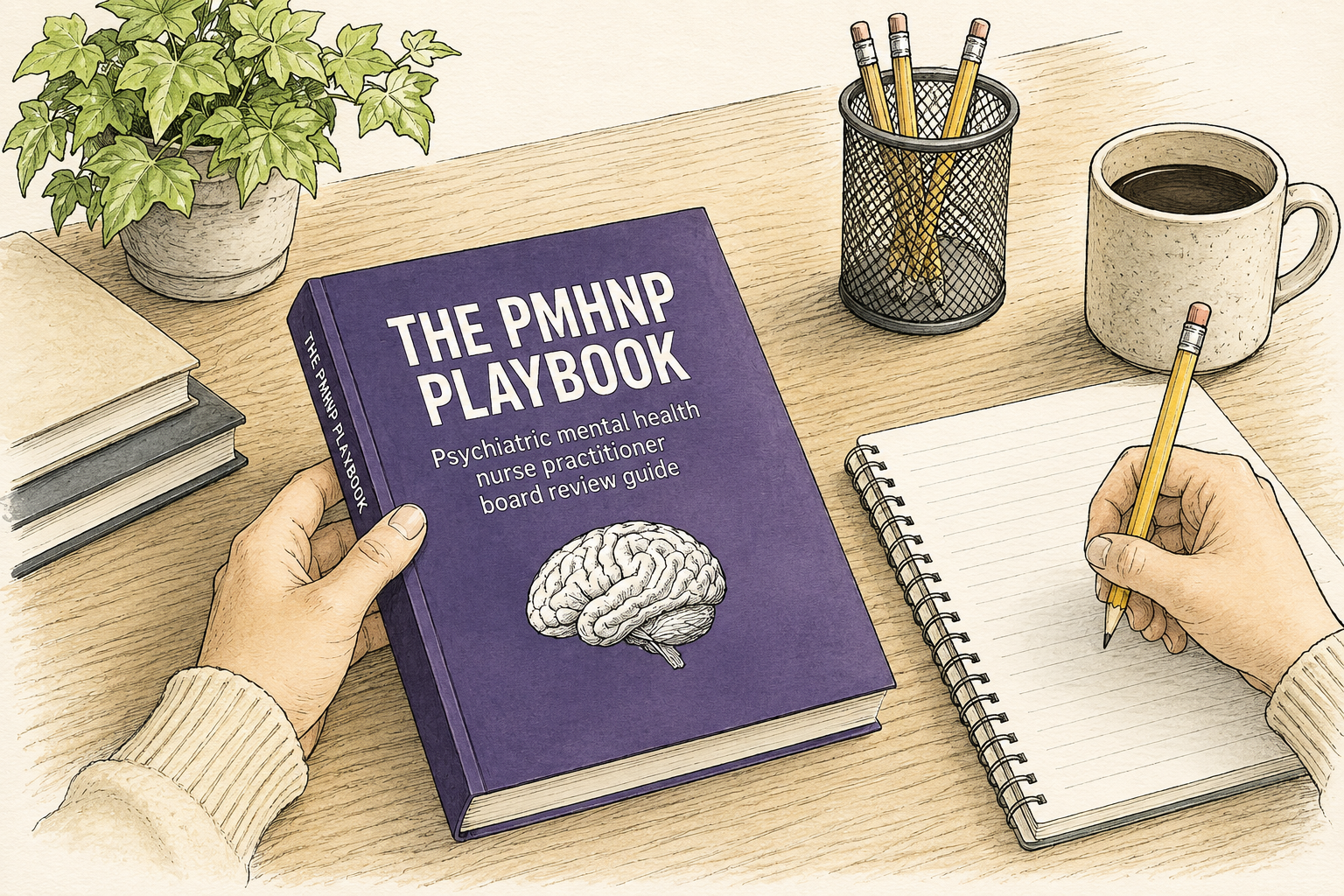
For a complete high-yield review of all five ANCC domains, The PMHNP Playbook brings the science, clinical reasoning, psychopharmacology, therapy, and legal concepts together in one place—without all the fluff.
Prefer digital? Buy the PDF edition
