
By Aislinn Ozawa Burns, MSN, PMHNP-BC
Involuntary hospitalization can feel complicated because it sits at the intersection of patient rights, safety, and the law. But for the PMHNP boards, the questions tend to come back to a few key ideas: Why is this patient being hospitalized against their will? Is there enough justification to restrict their rights? And are we using the least restrictive option that can safely meet their needs?
Once you know what to look for, these questions become much easier to work through.
What Is Involuntary Hospitalization?
Involuntary hospitalization, sometimes called involuntary commitment, allows a patient to be hospitalized for psychiatric treatment without their consent when specific legal criteria are met.
Normally, a competent adult has the right to accept or refuse treatment. Involuntary hospitalization is an exception because there are situations where the immediate need to protect the patient or others outweighs that right.
This connects closely with informed consent and decision-making capacity, since a patient's ability to understand and make treatment decisions can become important when questions about refusal of care come up.
The exact laws and terminology vary by state, so don't get too caught up in memorizing one state's process for the PMHNP exam. Focus on the underlying principles.
When Can a Patient Be Hospitalized Involuntarily?
The three criteria you should know for the boards are:
Danger to self
Danger to others
Grave disability
A patient generally needs to meet at least one of these criteria as a result of a mental disorder.
Let's break down what each one actually looks like.
Danger to Self
The most obvious example is a patient at significant risk for suicide.
Imagine a patient with severe depression who tells you they plan to die by suicide tonight, have access to the means, and don't believe they can keep themselves safe.
That is very different from a patient who reports occasional passive thoughts like, "Sometimes I wish I wouldn't wake up," but denies intent or a plan and can participate in a safe outpatient treatment plan.
The boards may give you both types of patients and ask who requires hospitalization. Suicidal thoughts alone don't automatically mean involuntary hospitalization. Look at the entire risk picture, including intent, plan, access to means, protective factors, and the patient's ability to maintain safety.
Danger to Others
A patient may also meet criteria when there is a serious risk of harm to another person.
For example, a patient experiencing psychosis who states that they are going to kill their neighbor and has a realistic plan and access to a weapon presents a very different level of risk than someone who simply says, "I hate my neighbor."
Again, context matters. The exam is looking for evidence of credible and significant danger, not just anger, irritability, or disturbing thoughts.
This can overlap with another heavily tested legal concept: Tarasoff and the duty to protect or warn. Involuntary hospitalization addresses whether the patient needs to be detained for safety, while Tarasoff-related questions address your responsibilities when a patient threatens an identifiable person.
What Does "Gravely Disabled" Mean?
This is where questions can get a little less obvious.
Grave disability generally refers to a patient's inability, because of a mental disorder, to provide for essential needs such as food, clothing, or shelter.

Imagine a patient experiencing severe psychosis who has stopped eating because they believe all food has been poisoned. They are becoming medically compromised but don't recognize that anything is wrong and refuse treatment.
The concern isn't simply that the patient has psychosis. It's that the illness has impaired their ability to meet a basic need and has created a serious safety risk.
This distinction matters.
Being homeless does not automatically mean someone is gravely disabled. Having schizophrenia does not automatically mean someone is gravely disabled. Making choices you disagree with does not automatically mean someone is gravely disabled.
Look for the functional consequence of the psychiatric illness.
The Least Restrictive Alternative
One of the most important concepts to remember is that psychiatric treatment should occur in the least restrictive environment that can safely meet the patient's needs.
Involuntary hospitalization significantly limits a person's autonomy, so it shouldn't be used simply because inpatient treatment would be easier, more convenient, or more intensive.
If a patient can safely be treated with outpatient care, crisis services, a partial hospitalization program, or another less restrictive level of care, that option should generally be considered first.
On the exam, pay attention to words like imminent danger, unable to maintain safety, severe impairment, and unable to meet basic needs. These clues may tell you that a less restrictive option is no longer sufficient.
Voluntary vs. Involuntary Admission
A patient who recognizes that they need help and agrees to inpatient treatment may be admitted voluntarily.
This is generally preferable when clinically appropriate because it preserves more of the patient's autonomy.
But willingness to leave the hospital doesn't necessarily mean the patient can leave immediately.
If a voluntarily admitted patient asks to leave and the treatment team determines that the patient now meets criteria for involuntary hospitalization, the appropriate legal process may be initiated to prevent an unsafe discharge.
For the boards, keep the underlying principle in mind: the patient's current level of risk determines whether restricting their liberty is justified.
Does Involuntary Hospitalization Mean You Can Force Medication?
No, and this is an important distinction.
Being hospitalized involuntarily does not automatically eliminate a patient's right to refuse medication.
Patients generally retain the right to participate in treatment decisions and refuse medications unless an additional legal or emergency exception applies. This is another place where understanding informed consent and capacity becomes important.
In an emergency, medication may sometimes be administered without prior consent when necessary to prevent immediate serious harm. Outside of an emergency, additional legal procedures may be required before medication can be administered over a patient's objection.
So if an exam question tells you a patient is on an involuntary hold, don't automatically assume that means you can force whatever treatment you think is appropriate.
Involuntary hospitalization and involuntary medication are separate issues.
Patients Still Have Rights
An involuntary psychiatric admission doesn't erase a patient's rights.
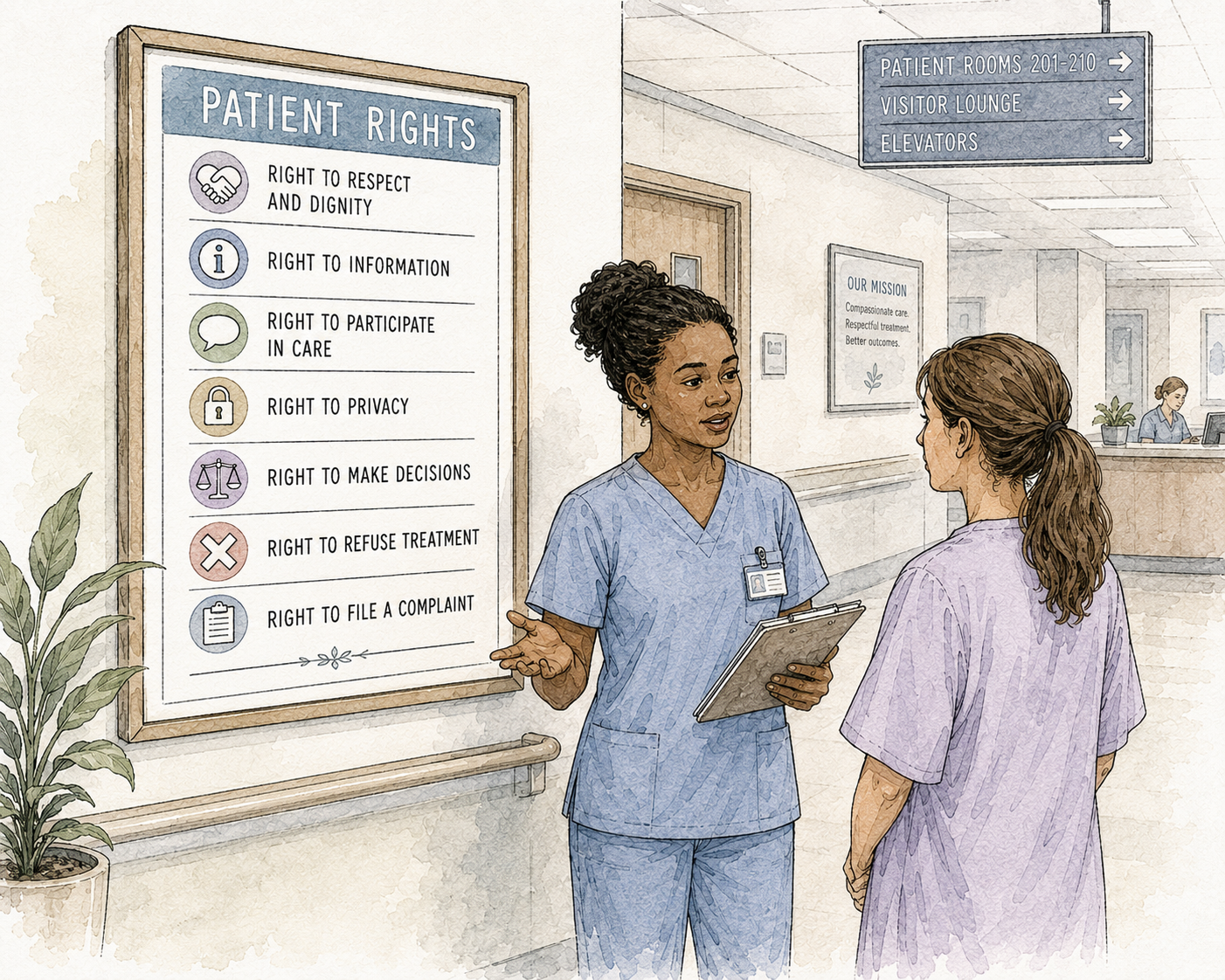
Patients generally retain rights related to humane treatment, privacy, communication, participation in their care, and freedom from unnecessary restraint or seclusion.
These concepts are closely tied to informed consent, capacity, and patient autonomy.
Restrictions should have a clinical or safety justification rather than being used for convenience or punishment.
This connects back to the same principle you'll see throughout psychiatric nursing questions: protect safety while preserving as much autonomy as possible.
Emergency Holds and Longer-Term Commitment
Many jurisdictions allow a short-term emergency psychiatric hold when a patient appears to meet criteria for involuntary hospitalization.
If continued hospitalization is necessary beyond that initial period, additional evaluation and legal procedures are generally required. Depending on the jurisdiction, this can involve hearings, judicial review, or other due process protections.
For the PMHNP boards, you usually don't need to memorize every state's hold duration. What matters is understanding that involuntary hospitalization requires legal justification and due process.
If a question gives you a specific state law or timeframe, use the information provided in the question rather than assuming every state follows the same rules.
How to Approach These Questions on the PMHNP Exam
When you see an involuntary hospitalization question, start by asking:
Is this patient an immediate danger to themselves, a danger to someone else, or unable to meet essential needs because of their psychiatric condition?
Then ask:
Is there a less restrictive way to keep them safe?
Those two questions will get you through a lot of scenarios.
A patient can have severe mental illness without meeting criteria for involuntary hospitalization. A patient can refuse recommended treatment without automatically meeting criteria. And a patient can make a decision you think is unwise while still having the right to make it.
The diagnosis itself isn't what justifies taking away someone's liberty. The risk and functional impairment are what matter.
Legal and ethical questions like these show up across the ANCC PMHNP exam domains, so learning the reasoning behind them is more useful than trying to memorize isolated rules.
The Takeaway
For the PMHNP exam, remember the core framework:
Danger to self. Danger to others. Grave disability. Least restrictive care.
Then keep the legal pieces separate. Involuntary hospitalization doesn't automatically authorize involuntary medication. Patients retain rights even when hospitalized against their will. And because commitment laws vary by state, focus on the broad legal and ethical principles unless the question gives you a specific jurisdiction.
When a board question feels complicated, bring it back to safety versus autonomy. Is there enough risk to justify restricting this patient's freedom, and is hospitalization the least restrictive safe option?
That's usually what the question is really asking.
Want more high-yield legal and ethical review for the ANCC exam? Read my guides to confidentiality and Tarasoff and informed consent and capacity.
If you're still organizing your board prep, you can also review the five ANCC PMHNP exam domains or follow my 8-week PMHNP study plan.
For the full breakdown of patient rights, legal and ethical concepts, and high-yield board content, it's all covered in The PMHNP Playbook.
Prefer digital? Buy the PDF edition
