By Aislinn Ozawa Burns, MSN, PMHNP-BC
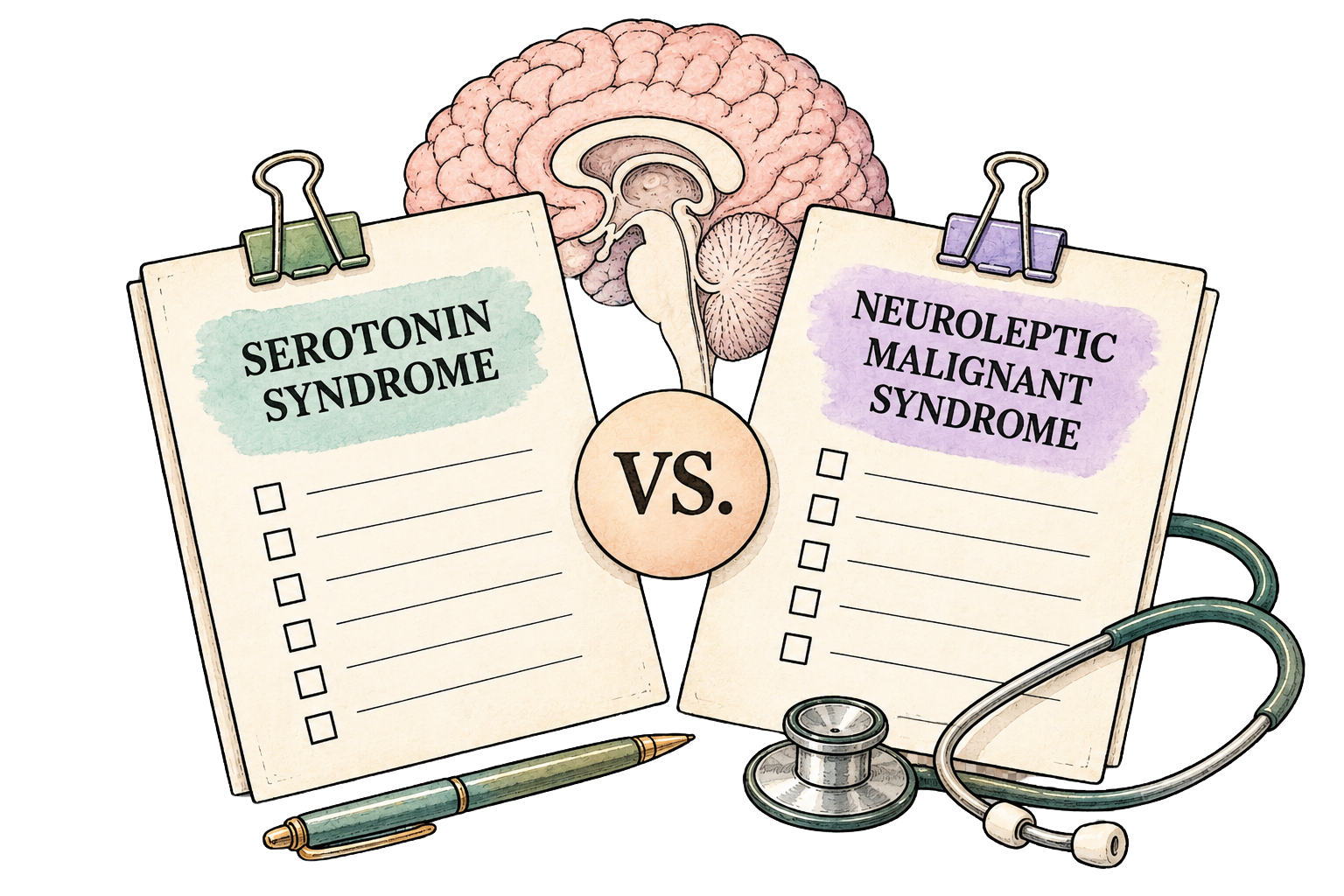
Serotonin syndrome and neuroleptic malignant syndrome (NMS) can look similar at first: fever, confusion, sweating, and unstable vital signs. The useful question is what separates them once you look more closely.
The PMHNP Playbook gives you the core recognition clues. Here, we'll build on those clues: what clonus and rigidity actually mean, why the medication timeline matters, and how to choose the first action in a clinical question.
Educational content for PMHNP board preparation. These fictional practice questions are not official ANCC items. Suspected medication emergencies require immediate clinical assessment.
Start With the Core Pattern
Serotonin syndrome: serotonergic exposure, rapid onset, hyperreflexia, and clonus.
NMS: dopamine blockade, more gradual onset over days, lead-pipe rigidity, decreased reflexes (hyporeflexia), and often elevated CPK.
Both: recognize the emergency, stop the offending medication, and initiate urgent supportive care.
Use that pattern to organize the question. Then ask which findings actually distinguish the two. Fever and tachycardia tell you the patient is ill, but either syndrome can cause them.
Why the Movement Findings Matter

In serotonin syndrome, excessive serotonergic activity produces neuromuscular hyperactivity. Hyperreflexia means an exaggerated deep tendon reflex. Clonus is a series of rhythmic, repetitive contractions, such as repeated ankle beats during an examination.
That combination is much more informative than agitation alone. A patient can be restless for many reasons. Restlessness together with clonus and brisk reflexes after a serotonergic medication change forms a recognizable pattern. Clonus was a central finding in the original Hunter serotonin-toxicity study.
With NMS, think about severe dopamine blockade and sustained muscle rigidity. “Lead-pipe” describes persistent resistance when a limb is moved passively. This feels different from the repeated beats of clonus.
For a board-style vignette, pair the movement finding with the exposure:
Clonus and hyperreflexia after a serotonergic combination point toward serotonin syndrome.
Generalized rigidity after an antipsychotic increase points toward NMS, especially with fever and altered mental status.
Ordinary antipsychotic-induced parkinsonism can also cause stiffness. Fever, confusion, and unstable vital signs should move your thinking beyond a routine movement side effect.
Clinical caution: these are typical patterns, not absolute rules. Timing and examination findings can overlap, and severe serotonin toxicity can also cause rigidity. Use the whole presentation; do not delay emergency care while trying to make every feature fit.
Read the Medication Timeline
A medication list tells you what the patient takes. The timeline tells you what changed.
For serotonin syndrome, look for a new serotonergic drug, a dose increase, an overdose, or a potentially unsafe switch. Sertraline plus tramadol is one useful example because the added medication may come from outside psychiatric care. The sertraline prescribing information warns about increased risk with other serotonergic drugs.
For NMS, look for an antipsychotic start or increase, particularly rapid escalation of a high-potency agent such as haloperidol. Second-generation antipsychotics can also cause NMS.
Why Washout Time Matters
The book flags inadequate washout during antidepressant switching. The reason is straightforward: a medication can keep acting after the last dose.
Fluoxetine and its active metabolite remain in the body for a long time. Its prescribing information requires at least five weeks after stopping fluoxetine before starting an MAOI intended to treat psychiatric disorders. A longer interval may be needed after long-term treatment or higher doses; follow the product-specific prescribing guidance. In the reverse direction, at least 14 days must pass after stopping such an MAOI before starting fluoxetine.
These intervals apply to that specific switch. They are not a universal rule for changing antidepressants. Check the medication-specific guidance. The learning point is that “discontinued” does not mean “already cleared.” Our pharmacokinetics review explains the half-life connection.
What Elevated CPK Adds to the Picture
CPK, also called CK, is an enzyme measured as a marker of muscle injury. In NMS, severe rigidity can be accompanied by muscle breakdown, or rhabdomyolysis. Damaged muscle releases myoglobin, and this can contribute to acute kidney injury. The haloperidol label identifies elevated CPK, myoglobinuria, and acute renal failure among the possible findings.
This explains why the book connects NMS with fluids and renal monitoring. The lab value helps you recognize muscle injury and assess complications.
High CPK supports the NMS picture, but it does not diagnose NMS by itself. Severe serotonin toxicity can also injure muscle. Keep the medication exposure and examination in the foreground, and do not wait for a lab result before responding to an unstable patient.
Separate the First Action From Additional Treatment
When a question asks what to do first, start with the book's safety principle: stop the offending medication. Suspected serotonin syndrome means stopping causative serotonergic agents; suspected antipsychotic-related NMS means stopping the causative antipsychotic.
Emergency assessment and stabilization happen alongside that decision. Supportive care includes fluids, cooling when needed, and close monitoring. Severe cases need intensive care. Fever with confusion, marked rigidity or clonus, or unstable vital signs is not a routine outpatient follow-up problem.
Then place the named medications in context:
Cyproheptadine: a serotonin antagonist that may be considered as an adjunct in serotonin syndrome.
Dantrolene: may be used in severe NMS to reduce muscle rigidity.
Bromocriptine: a dopamine agonist that may be used in NMS.
Evidence for these adjuncts is limited, including retrospective cyproheptadine data and analyses of reported NMS cases. They are specialist-directed additions to care. Choosing a familiar treatment name should never replace stopping the causative drug and stabilizing the patient.
Three Original Practice Questions
1. The New Pain Medication
A patient taking sertraline starts tramadol after an injury. Later that day, the patient develops agitation, sweating, diarrhea, tremor, hyperreflexia, and ankle clonus. Which diagnosis best fits?
A. Serotonin syndrome
B. Neuroleptic malignant syndrome
C. Antipsychotic-induced parkinsonism
D. Uncomplicated panic attack
Answer: A. The new serotonergic combination, rapid onset, and neuromuscular hyperactivity fit serotonin syndrome. The clonus and brisk reflexes are more useful discriminators than sweating alone. This patient needs urgent medical assessment.
2. The Antipsychotic Increase
Several days after a rapid haloperidol dose increase, a patient develops confusion, a temperature of 39.5°C, generalized sustained rigidity, and fluctuating blood pressure. What is the most appropriate response?
A. Continue haloperidol and repeat CPK tomorrow
B. Give benztropine and arrange routine follow-up
C. Stop haloperidol and arrange emergency evaluation and supportive care
D. Switch immediately to another antipsychotic
Answer: C. The medication change, gradual evolution, rigidity, and systemic findings suggest NMS. A delayed lab check or treatment for routine EPS misses the emergency. Stopping haloperidol and initiating emergency care take priority.
3. The Medication That Was Stopped
A patient stopped fluoxetine seven days ago. A new plan calls for starting phenelzine today. Which concern is most important?
A. Fluoxetine stops acting immediately after discontinuation
B. The washout is too short, increasing serotonin-syndrome risk
C. The main concern is dopamine blockade causing NMS
D. Every antidepressant switch requires exactly five weeks
Answer: B. Fluoxetine and its active metabolite persist. The labeled minimum before starting a psychiatric MAOI is five weeks after stopping fluoxetine. Seven days is insufficient. This is a medication-specific interval, so choice D incorrectly turns it into a universal rule.
Keep practicing with the serotonin syndrome vs. NMS question bank.
Frequently Asked Questions
Are CK and CPK different tests?
The terms refer to the same enzyme: creatine kinase, also called creatine phosphokinase. Recognize both abbreviations.
Does serotonin syndrome always cause fever?
No. Less severe cases can occur without hyperthermia. Assess the exposure and neuromuscular findings together.
Should I choose cyproheptadine when the question asks for the first action?
Look at the wording and the patient's condition. Stopping the offending medication and emergency stabilization come before relying on an adjunct medication.
The PMHNP Playbook Takeaway
Start with the book's recognition cues, then explain the reasoning: what changed, how quickly symptoms appeared, what the muscles and reflexes are doing, and what needs to happen immediately.
For the underlying mechanisms, revisit neurotransmitters for the PMHNP exam. Work this topic into your eight-week study plan, then explain each practice answer aloud before reviewing the rationale.